


.png)
Aurealis – Cursed: Darkness Without Escape
- hace 2 horas
- 5 min de lectura
There is a fine line between music that merely adopts the aesthetics of darkness and music that attempts to inhabit it. Across the past decade, the rise of cinematic pop, darkwave revivalism and melancholic electronic production has produced countless artists eager to wrap intimate emotions in glossy shadows. Too often, however, those shadows remain decorative—an aesthetic filter rather than a genuine emotional language. With Cursed, Aurealis attempts something more psychologically immersive. Rather than treating darkness as spectacle, the single positions it as an internal architecture, where doubt becomes a narrator and despair takes the role of protagonist.
That distinction matters because Cursed is not interested in gothic excess or theatrical melancholy. Instead, it explores something far quieter and ultimately more unsettling: the gradual erosion of hope. The song unfolds less like a conventional pop single than an internal monologue whose emotional tension comes not from dramatic shifts but from the slow realization that the voice inside your head may no longer be your ally.
Built around spacious electronic production, layered vocal arrangements and a restrained melodic structure, the track demonstrates an understanding that emotional weight often comes from absence rather than accumulation. Instead of overwhelming the listener with maximalist production, Aurealis leaves enough negative space for every synth texture and vocal harmony to acquire psychological significance. Silence becomes almost as expressive as sound.
That production philosophy immediately places Cursed closer to contemporary cinematic electronic music than mainstream synthpop. The electronics rarely seek dancefloor momentum. Their purpose is environmental, constructing an atmosphere that constantly feels suspended between dream and nightmare. Pads linger like fog, rhythmic elements emerge cautiously before dissolving again, while the harmonic progression avoids offering comfortable resolution.
This restraint proves to be one of the single's greatest strengths.
Where many independent electronic pop releases mistake density for emotion, Cursed embraces minimalism as a storytelling device. Every production choice serves the emotional narrative instead of competing for attention. The result is a composition that feels surprisingly visual even without its accompanying imagery.
Lyrically, the central idea revolves around an increasingly familiar contemporary anxiety: the feeling that failure has already been written before action even begins. Rather than describing external conflict, Aurealis turns inward, presenting the mind itself as the primary antagonist. The "curse" suggested by the title is not supernatural but psychological—a persistent internal voice insisting that every ambition is already doomed.
It is an idea that resonates strongly within the current cultural landscape. In an era dominated by uncertainty, burnout and relentless self-comparison, the song captures a form of emotional paralysis many listeners will recognize. Yet Aurealis avoids reducing those feelings to simplistic slogans about mental health. There is no easy redemption offered here, no motivational climax waiting in the final chorus. Instead, the track accepts ambiguity, allowing discomfort to remain unresolved.
That refusal to manufacture catharsis gives Cursed an unusual honesty.
Vocally, Aurealis favours intimacy over virtuosity. The performance avoids excessive ornamentation, allowing fragility to become part of the emotional vocabulary. Multi-layered harmonies occasionally blur the distinction between internal dialogue and external narration, reinforcing the central concept that the listener is witnessing an argument taking place entirely within one consciousness.
The effect recalls less the dramatic vocal performances associated with commercial pop than the understated delivery often found in atmospheric electronic music, where emotional nuance outweighs technical exhibition.
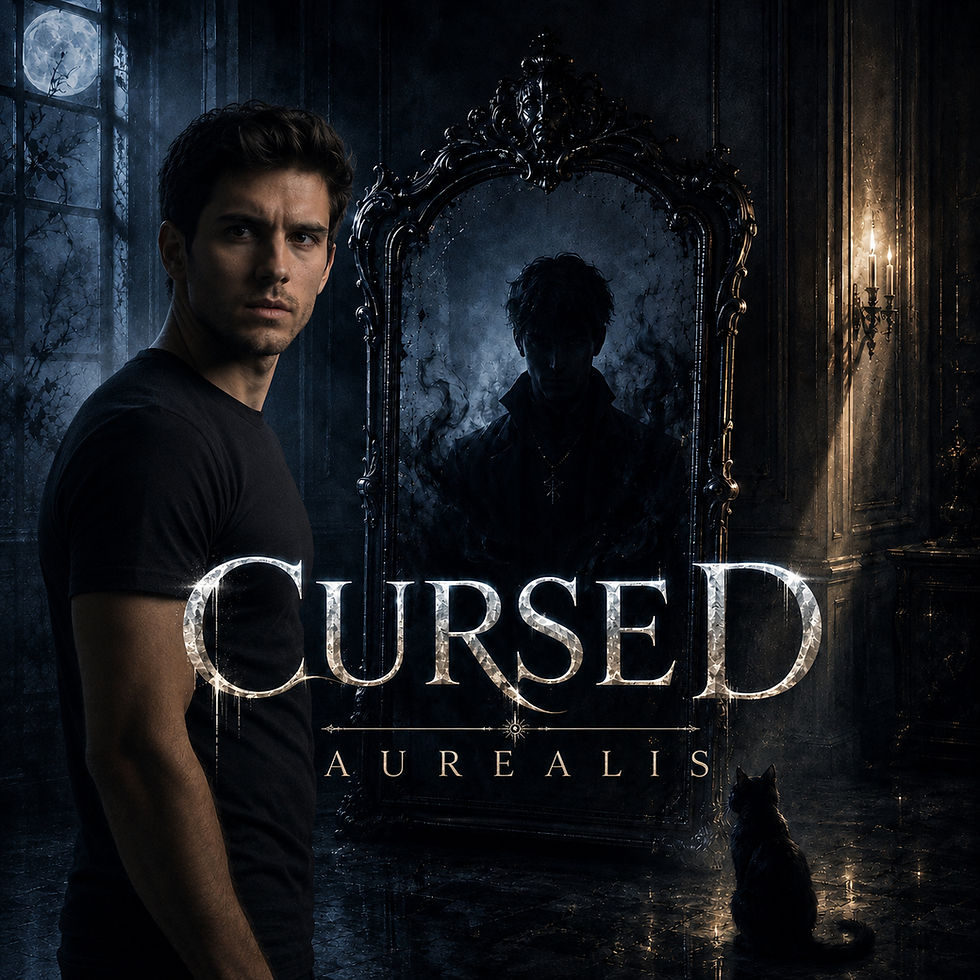
Equally significant is the relationship between the song and its visual component. According to the accompanying press material, mirrors, shadow imagery and surreal dreamlike environments form the basis of the official video, extending the psychological narrative beyond the music itself. Rather than functioning as promotional decoration, the visuals appear conceived as an essential extension of the composition's emotional world.
This interdisciplinary approach reflects an increasingly important evolution within independent music culture. Songs are no longer isolated audio experiences but components of broader artistic ecosystems where visual identity, narrative symbolism and sonic language reinforce one another. Cursed seems fully aware of that reality.
Interestingly, the project also openly acknowledges the use of AI-assisted creative tools during production while emphasizing that songwriting, artistic direction and conceptual authorship remain human-led. In today's creative landscape—where discussions surrounding artificial intelligence often become polarized—that transparency feels more productive than defensive. The technology is presented neither as marketing gimmick nor replacement for artistic vision, but as part of a wider creative workflow serving an already established concept.
Ultimately, what determines the success of a work like Cursed is not the tools employed but whether the emotional experience feels authentic.
For the most part, it does.
The composition succeeds because it never attempts to impress through technical spectacle. Its ambitions are emotional rather than commercial, psychological rather than algorithmic. Even when individual musical elements remain relatively familiar—ambient synth textures, restrained percussion, layered vocals—they are assembled with enough conceptual coherence to create a distinctive atmosphere.
If there is any limitation, it may lie precisely in that restraint. Listeners expecting dramatic structural development or explosive climactic moments may find the song almost too committed to its introspective pace. Cursed unfolds patiently, prioritizing emotional consistency over dynamic contrast. While that decision strengthens its immersive qualities, it also risks making certain passages feel intentionally static.
Yet perhaps that is precisely the point.
Depression rarely arrives in cinematic crescendos. Anxiety rarely resolves itself through perfectly timed key changes. The emotional state Aurealis depicts is repetitive, cyclical and resistant to narrative closure. The music mirrors that condition with admirable discipline.
In many respects, Cursed functions less as a standalone single than as an invitation into a larger artistic identity—one rooted in cinematic storytelling, emotional symbolism and carefully controlled atmosphere. It suggests an artist more interested in constructing immersive psychological environments than chasing streaming-friendly immediacy.
Whether Aurealis ultimately develops this aesthetic into a broader body of work remains to be seen. But Cursed offers an encouraging indication of creative direction. It understands that darkness becomes compelling not when it is performed theatrically, but when it reflects recognizable emotional experience. Beneath its electronic textures and shadow-filled imagery lies a surprisingly human question: what happens when the loudest voice in your life is the one convincing you not to believe in yourself?
Rather than pretending to answer that question, Cursed simply inhabits it.
And in doing so, Aurealis delivers a debut statement whose greatest achievement is not its melancholy, but its quiet refusal to dilute it into easy optimism. Like the most effective cinematic works, the song lingers not because of what it explains, but because of what it leaves unresolved. That lingering uncertainty becomes its true hook—a reminder that some of the most compelling electronic pop today is less concerned with escaping darkness than with learning how to give it a voice.
Official Music Video Preview: https://youtu.be/iRlZUYvFqhY
“Cursed” is an original Aurealis song, with lyrics, melody, and song structure written by Aurealis. The final production and visuals were created using AI-assisted tools as part of a human-led creative process.
At its core, “Cursed” is about the moment when hope starts to disappear - and the fight to keep it from going silent.
Release date: June 26, 2026
Artist: Aurealis
Release: Cursed
Style: Dark cinematic pop / electronic pop / synthpop
Audio Preview:https://youtu.be/H84U5mADPlg
Official Music Video Preview: https://youtu.be/iRlZUYvFqhY


Comentarios